Friday, March 23, 2018

The connection between the original UNP development and the proposed development for the north is important.

Some interesting developments. (See Minutes from TIF #2 Oversight Committee, 2/20/2018)

1.  Carmax to move into the UNP North area.  Agreed upon by Target Corpoation, UNP, LLC, the developer of the sought half; and UTC, LLC, the developer for the North half of the University North Park development. Car dealerships were restricted in certain areas but not the whole development.

2. Terra Apartments should be open for occupancy over the next month. They, in fact, are. https://www.apartments.com/terra-at-university-north-park-norman-ok/0k2xqr2/

3. 16 businesses have closed during the tenure of the TIF.  Chair Walden claims this is a good track record. [Is it? Is this better than the rest of Norman?]

Things coming forward:

Resolution to use the $8.75 million in the TIF #2 fund for cultural center for senior and cultural center to be located roughly near the YMCA and 2 other new Norman Forward projects.  This will be discussed 3/27/18 TIF #2 Oversight Committee. Council already approved the resolution. It needs to move to the TIF Review committee now. [But maybe it does not if it falls within the minor change category.]

The City Manager, Steve Lewis, continues to allow the use of the City Logo on a PR page for the arena-entertainment district facebook page.  Council has done nothing to stop this.


Thursday, March 8, 2018

This article discusses the impacts of neutral sites for the final 4 games in Women's NCAA basketball games. 

Neutral sites have adverse impacts on attendance. This is important for considering building infrastructure with the intent of hosting NCAA basketball events. 

http://www.excellesports.com/news/womens-ncaa-tournament-attendance-neutral-sites/
NCAA Basketball Attendance declines continue to be a challenge.

The desire to increase revenue generating potential of college basketball is not new.
The playing field, however, is changing. Technology is part of the challenge.

https://www.coloradoan.com/story/sports/csu/2018/01/19/why-csu-mountain-west-basketball-attendance-plummeting/1048090001/


The NCAA Division I teams have seen a gradual but steady decline the past five full seasons, with average attendance of 4,633 last year, a 6 percent decline, and a 13 percent decline from 10 years ago.
There are likely several issues at play here, including an increase in televised and streamed games.
The challenges that Men's College Basketball face in Oklahoma are numerous. Competition with the Thunder NBA team is just one challenge.

Here is a quote from an article from AthleticBusiness.com from June 2012.

"The arrival of the NBA's Thunder in Oklahoma City is believed to be one contributor to what the Tulsa World in March termed an attendance "crisis" among the state's major college men's programs. In recent years, Oklahoma and Oklahoma State have both witnessed double-digit percentage declines in attendance, and Tulsa University's arena was more than half empty for most games last season. "People only have so much money to spend on basketball, so what game do you want to take your son to? Probably a Thunder game," former TU player Jason Parker told World sportswriter Bill Haisten. "I've been to three TU games this year, and I've been to three Thunder games. The Thunder games are always a great show, no matter where my seat is. That building is electric."

Have things improved since 2012? Maybe the Thunder novelty effect has worn off?

https://www.athleticbusiness.com/college/men-s-college-basketball-programs-facing-attendance-declines.html

Saturday, March 3, 2018

Roger Noll, Standford Economist, has been studying arenas for a long time.
He cautions against football arenas which have too few events and supplemental uses.
Basketball arenas are more promising IF you can get 300 or so events a year.

For Norman, we need to consider a plan which would leave the city with 2 large arenas plus 2 fair grounds type facilities (county fair grounds and the proposed new expo center in the UNP North plan).

https://l.facebook.com/l.php?u=http%3A%2F%2Fwww.econtalk.org%2Farchives%2F2012%2F08%2Froger_noll_on_t.html&h=ATO9WMtay3vPbOKh2BXnRxsTottY1mBmznEvSFsF2sezsYZHqjSGP0PHnm-HueLdZyTThwZY3ot2U7JULuZ37jy59ceEWOKnJQDyig

Friday, March 2, 2018

What can we learn from Lincoln's Arena Deal?


Interesting article on the Pinnacle Bank Arena which hosts U. of Nebraska Basketball team. What can we learn from it?


Project Overview:

The $190 million arena is part of a $344 million total redevelopment project, which includes purchasing existing railyard and lumber yard.

Public Financing
(1)  Voters approved $25 million general obligation bond
(2)  New Occupational taxes implemented to pay off the debt for the project
a.     4% tax on hotels and rental cars
b.     2% tax on restaurants and bars

There are 3 partners:

(1) Joint public agency (JPA) oversees the arena and the West Haymarket district
      -    Revenue from advertising, pouring rights, suite and premium seat sales, naming rights
-       Naming rights: $450,000 a year for 25 years ($11.25 million total) but discounted to $6,731,958 for accelerated payment.

(2) Arena – separate operator – covers operating expenses
      -     Revenues from festival parking lot, and share of revenues from basketball games

(3) University of Nebraska-Lincoln (Audit document)
Rental agreement:  $750,000 /year initial rent adjusted for inflation
Credits for share of ticket sales, $300,000 lost concessions adjusted for inflated
Net Rent was $312,000 in 2017

Revenues: Received $315,000 for share of premium seat sales in 2017

Sources:
Lincoln documents - https://lincoln.ne.gov/city/finance/account/jpa.htm
Audit - https://lincoln.ne.gov/city/finance/account/pdf/2017-08-31-JPA-Audit.pdf

Naming rights: http://journalstar.com/news/local/consultant-sues-over-commission-paid-for-arena-naming-rights/article_7f3a349c-7f36-527c-a3e9-09b05b395868.html

Watchdog article: https://www.watchdog.org/nebraska/beutler-acknowledges-arena-is
-losing-money-lincoln-newspaper-doesn-t/article_ae89f43c-3206-582e-a7e0-0baebf694bc0.html


Thursday, November 16, 2017


The OU Student Government Association and Econ Club hosted a panel discussion on TIFs.
These are my slides.  I have added notes below each one.


NOTE: The "But For" condition is more difficult to establish for Greenfields.

Note: This is an example for the University North Park TIF in Norman, OK.  

Note: Above is a classic picture of how TIF works.  Note the targeted area is declining or stagnating (satisfies the But For condition).  The tax revenues are frozen at the base level. Growth in tax revenues in the district are re-invested in the district.  Borrowing can be done and paid back with the increment growth. At the end, the City gets the who value of the base + the increment.

Note: There are a lot of players. Keep in mind that interests may conflict. Lawyers may work for developer or the gov. Consultants may get paid to manage the contracts. Schools give up (or receive a bonus) from freezing the base.

The growth in the increment may not be an accurate measure of the impact of the investment.  The extra growth resulting from the investment is the difference between actual increment growth and the alternative “No-TIF” scenario.  If nothing would have happened at all (think brownfield or high poverty neighborhood) then the increment might be a good measure of TIF impact in the district.  More than likely (especially for greenfield development) some growth would have happened without the TIF. 

The increment may be split between the TIF district and the taxing jurisdiction. The impact on the budget would depend on the difference between the City’s take in the TIF vs. the NO-TIF scenario. (We don’t observe the no-
tif scenario).
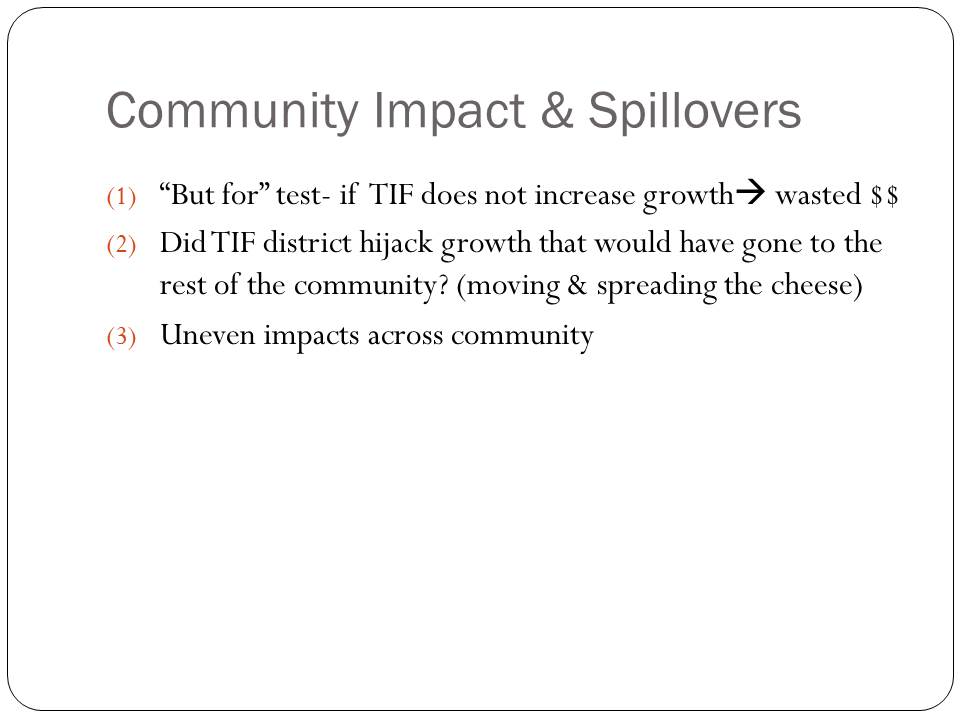
Note: It isn’t enough to look at what happens just inside the TIF b/c the TIF project can detract from or enhance growth in the rest of the community.  If the TIF does not pass the but for test, then the TIF “wasted” $.  The TIF might also grow at the expense of the rest of the community

Note: One type of cannibalization is where stores or private investment relocates within the TIF. This may be new to the community or it may be relocations within the community. Relocations within the community do not add a net benefit. (Move the cheese )

Note: Another type of cannibalization is where shopping activity shifts to the TIF district and away from the non-TIF district.  This can impact the City budget b/c the City only gets a share of the TIF increment growth. The stores outside the TIF suffer from the TIF competition. (spread the cheese)


Note: A good first approximation of overall impacts within and outside the TIF is to look at the total sales tax base (or advalorem if property taxes are involved).  In the above graph we do not observe a bump in total sales tax activity after the University North Park TIF.  Norman's trend is similar to that of other cities in the region, Edmond and Moore.  This is not a clean analysis because Edmond and Moore use TIFs also. 


Note: TIFs are a tool that can be used to enhance growth and development if used for the right sort of projects and designed properly.  TIFs can impact city budgeting in important ways.
These deals need very careful analysis from objective parties vs. stakeholders who have a hand in the pot.